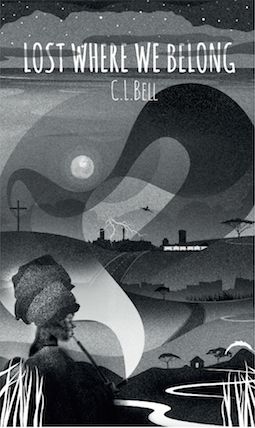
This week sees the publication of my narrative non-fiction book, Lost Where We Belong. Set over five years in South Africa, Lost Where We Belong is a narrative about belonging, racism, guilt and the struggle for self-identity – issues that exist both in South Africa, and all over the world today. This week’s Unpopular Essay is an extract from the book.
Chapter 6: You’ve got to have Faith
I am heading north, away from the dense sub-tropical humidity of the Pondoland coast, up to the grassy plains of the AmaXhosa. The road from Port St Johns up to Mthatha swings from left to right and back again, like a conductor’s baton leading a gentle symphony. This morning the rhythm of the road is soothing, and as I drive, hooting at errant cows and goats and flashing my lights to warn fellow drivers of the beasts ahead, my fear momentarily ebbs and I breathe in the easy companionship of the open road.
I arrive in Mthatha in the morning rush hour. The cows and goats are replaced by laughing school children and busy women balancing maize and sugar on their heads and babies on their backs. A jolly policeman points me in the direction of the Ncgobo road.
“Are you traveling alone?” he enquires, a little surprised.
“My husband’s coming tomorrow,” I lie.
“Eish, he better keep an eye on you,” he says with a laugh.
“Don’t worry, he is,” I say wryly.
Ngcobo is eighty kilometres north of Mthatha along a narrow, rollercoaster type road that passes through grazing lands and forested hills. I drive with the window down, the soft air cooling my cheeks, smiling at the morning. An hour later, I arrive in the heart of the bustling market town. I park the car at the back of the petrol station and head out into the sea of humanity to find Faith. I have barely gone a few metres when a full-bodied turquoise figure sporting a wide smile, a stylish black bobbed wig and a matching blue headscarf appears out of the crowd.
“Your hair!” I exclaim, as we give each other a hug.
“You like it?” she asks.
“It looks fabulous,” I reply, feeling a kinship with the fact that Faith had put on her glad rags to go home. When I first moved to London, I used to love sporting all the latest fashions on my trips back to Benoni. It was a sign to myself, and to everyone else, that I had got the hell out of that Hicksville. I got the sense that Faith had returned to Ngcobo with the same intent.
We climb into the bakkie, chatting idly about our journeys as Faith directs me out of town, past the new suburbia of identikit social housing built in neat rows, too close together, leaving little room for plants and people to grow, and onto a dirt track. The track splits and Faith is not sure which fork to take. Within a few minutes we are already lost.
“Sorry,” says Faith. “I’m usually in the back of the bakkie. The driver always knows the way.”
“Not this driver,” I reply.
We reverse and try again, and are soon gathering speed down the best dirt road in the Transkei.
“Walter Sisulu built this road for us,” Faith says with a hint of pride.
We drive on into a wide open landscape under big skies. After half an hour, we come across a bunch of teenagers thumbing a lift. We stop to ask where they are going. Faith shakes her head, winds up the window and indicates for me to keep driving.
“You didn’t like them?” I ask.
Faith shakes her head. “Their village is at the far end of this valley. We can’t take them there. This good road doesn’t go all that way. It becomes bad later on.”
The journalist in me says nothing. It is a big job to fix decades of neglect. But I also notice gritted teeth, and an inner eyeroll. Why is it that the ANC fought for equality of all South Africans, and yet equality of public services seem to stop at the driveways of the new political elite?
After three quarters of an hour, we arrive in Kanye. The village is built on a gentle slope overlooked by ancient volcanoes, their slopes carpeted with long grass and dense forest. Down in the village, puffs of smoke whirl up from thatched huts while sheep and mongrel dogs laze in fenced-in kraals. As we pull up, an old man rides by on a brown horse. There is a heavy silence in the air, perhaps the silence of a village that is used to keeping its voice down.
Faith opens the gate to her mother-in-law’s homestead and directs me to park the bakkie outside her bedroom window. I edge forward, avoiding an old supermarket trolley lying on its side, three puppies, a dog, and a handful of chickens pecking at the ground.
“You have got an alarm on it, haven’t you?” Faith asks as I climb out from behind the wheel.
This is the first time she has suggested there is anything to worry about. I nod.
“Oh, I’m sure it’ll be fine,” she says. “There’s only one man in the village I don’t trust. But it’ll be fine. We’ll ask him to look after the bakkie for us. If you want to stop a thief from stealing from you, ask him to help you.”
Eight-year-old Anna, 9-year old Kamva (who everyone calls Junior), 12-year-old Thembi and 74-year-old Aunice Hlakula are standing on the steps of the hut waiting for us. Mrs Hlakula is tiny, wrinkled and is keenly aware of her place in the village hierarchy. We have barely put down our bags before she instructs us to get back in the bakkie and go visit Mrs Hlakula, the other one, the really important one, the one that is a daughter-in-law to the late Walter Sisulu. Faith and I both wrinkle our noses, tired from our journey, but Mrs Hlakula is insistent. “Go visit Mrs Hlakula. Then you can be sure no one will steal the bakkie,” she says in Xhosa. So Mrs Hlakula and I take Mrs Hlakula’s advice and go and visit Mrs Hlakula.
It is late afternoon and the clouds have drawn in, cloaking the rich green with a sleepy grey. Ellen Hlakula lives in a pink bungalow at the highest point of the village. As I wait for Faith to open the gate to the homestead, it strikes me how closely this scene resembles a Scottish Highland crofting village, except here the houses are brightly coloured, rather than white washed. As we approach the front door, a young girl is standing outside, staring up to the hills, unsmiling, her eyes empty.
“Come in, come in,” Mrs Hlakula says, as she sees us approach. She is an elderly, rotund lady dressed in a blue and white wave-print dress and a red turban. She calls a young man to bring out a tray prepared with cups of coffee and slices of buttered bread.
We sit down and I thank her for inviting me into her home, commenting how beautiful the surrounding nature is. She nods, offers me coffee, and then gets straight to the point.
“What are you doing here?” she asks. Her face is now unsmiling. She stares me hard in the eyes.
I am unnerved. I am used to black women always being polite to me, always addressing me through a veneer of jolly kindness, but here in Mrs Hlakula’s home, there will be no pretend deference. I have not been summoned here to be welcomed, I am here to be observed and have my motives assessed. The mood is of mistrust and suspicion.
I repeat my well-rehearsed monologue about wanting to understand how democracy has changed life for people in the rural areas, and she replies with her own well-rehearsed speech about the success of their new local primary school, built by Walter Sisulu, the advent of pensions for old people, the excellent road into town, and the fact that all the houses in Kanye now have access to running water.
As she talks, I scan the room, taking in the rich peach walls, the wall unit, the comfortable lounge suite, the sepia photo of a white-haired Walter Sisulu in his trademark 1960s-style spectacles with his wife Albertina, smiling, her hair coiffed into a stylish Afro. In most of the homes I have visited so far, there has been no art on the walls, just black and white portraits of family members and ANC posters, but here, propped up behind a crystal punch bowl is a stylised painting of an African woman, with a triangular Afro and a beaded necklace. It reminds me of the kind of painting a white tourist would buy as a souvenir of their safari holiday. The idealized version of the African woman. Proud. Noble. The exotic queen. I grew up in a home decorated with these images. Regal, carved African heads and beaded Zulu weapons – spears and knobkerries – mounted on the wall. Ironically heralding the same culture that we were oppressing.
My turn to speak again. I press Mrs Hlakula. Surely there must be something that worries her. Something that keeps her awake at night. She nods.
“Our problem is the bottle stores,” she says. “There are so many bottle stores and they are disturbing our lives. Life is not all right because of alcohol. Our children are drinking and taking drugs, we are so worried about that. Even the girls are drinking. They start drinking age 12 and 14. They are drinking because they are bored. One day they beat the headman for no reason. They did it out of drunkenness.”
Mrs Hlakula rises and I follow her out onto the porch where the little girl is still standing, looking out to the hills.
“She is not right,” Mrs Hlakula explains, pointing at her head. “She is not my grandchild, but I am looking after her now. Both her parents are dead, and she has no one to look after her. It is a shame.”
I realize what I am witnessing here is Ubuntu, the African philosophy that believes that our humanity is intertwined and that we gain our humanity through caring for each other. In a true African village, there are no orphans. I am because you are. It could not be further from the philosophy of apartheid: I am, because you aren’t.
On the front steps a goat has curled up, soaking up the last of the warmth from the cement. We all laugh and I ask if I can take a picture.
“You can take a picture of the goat, but I do not want my house in the background,” Mrs Hlakula says.
I nod. Dignity was hard fought for and won by this family and Mrs Hlakula will not have it undermined by a white woman with unclear motives. I respectfully zoom in on the goat, and then we say our goodbyes and climb into the bakkie.
“She didn’t trust me, did she,” I say to Faith as I start the engine.
Faith just laughs.
*
That night Faith and I get undressed by candlelight, and climb into her marital bed, giggling. Faith has placed a yellow bucket in the corner of the room so we can pee in the night without having to traipse through the mielie field to the long drop. As she changes into her pyjamas she gives me a brief lesson in how it is done, sound effects and all. I am relieved to be sleeping so close to her. My paranoid fear of being woken in the middle of the night by a dark prowler with a fancy for white flesh is ebbing away, and instead I feel like a teenager at a slumber party, Faith in her pink satin pyjamas checking her mobile phone for messages, me in my nightie, both too excited to go to sleep.
We have barely been in bed two minutes, when Faith leaps up, shrieking.
“What?” I whisper, sitting bolt up right, the terror ebbing back.
“Did you hear that?” she whispers.
“What?”
Outside the window a bird chirps.
“A snake!” she hisses.
“It’s a bird,” I say.
“Eish, I hate snakes,” she says, grabbing the candle and scouring the corners of the room. “If one comes you must protect me.”
“But… but… what do I know about snakes?” I ask.
“It doesn’t matter. You’re braver than me,” Faith says.
At this point I start laughing. It feels good to laugh. In fact, it feels great. It is as if that deep fear that has been swirling around in my belly is pouring out of my mouth and vanishing into the ether.
Faith however, is not amused. Climbing back into bed, she blows out the candle and announces: “Then we’ll just have to ask God to protect us both.”
Faith is the wife of a preacher. At the end of our first meeting in her home in Khayelitsha, we stood in a circle and held hands and Faith asked God to bless me. Tonight, as she says her prayers out loud, I take the opportunity to have my own quiet word. I am not religious in any denominational sense, but I have experienced enough amazing co-incidences and helping hands when you least expect it and most need it, to believe that there is something which connects us all together, something far greater and more mysterious than our small, rational brains could ever hope to comprehend. Take the fact that when I was sitting in Cape Town, wondering how the hell I was going to get myself invited to a rural village, the universe sent me Faith. I love the poetry in that. So tonight, I close my eyes and say quietly: “Thank you for Faith.”
*
The day starts early in Kanye. An enthusiastic cockerel wakes me up at 4am. And 5am. And 6am. I hope he tastes better than he sounds.
I stumble out of bed once the children are on their way to school. Faith is already in her mother-in-law’s kitchen, a standalone yellow bungalow, the inside walls painted a bright pink. The floor is scrubbed with cow manure, as is the custom, and a mishmash collection of metal pans, tea pots and plates are spread between an old wooden sideboard and a Scotch dresser. Nothing is very clean. Old Mrs Hlakula is too frail to do housework anymore so Faith is getting stuck in. I help by taking our pee bucket down to the long drop inside a tiny corrugated iron shack, exchanging a cheery “molo” with our nextdoor neighbour. Over the next couple of days, we meet every time I have to pay a visit. Greater society might not think we have much in common, but our bowels would disagree.
Back at the house, Faith asks me if I want to bathe. I nod and she winks and hands me another bucket, just big enough to crouch in, and pops on the kettle. Faith is clearly enjoying all of this. The image of me balancing precariously over her bucket trying to scrub my bum will probably keep her amused for years to come. While the kettle boils, we sit down and do what most women do in the kitchen: skinner (gossip). Faith fills me in on the internal politics of her family, and of who will and will not inherit the Kanye homestead. The hot gossip is that although Thembi, Junior and Anna are the orphaned children of Faith’s sister-in-law, meaning by tradition they should now be taken care of by the family’s eldest brother, the brother has refused because the children were fathered by a man from the Venda tribe. The Hlakulas are Xhosa.
“He is a racist,” Faith says disapprovingly, clicking her teeth.
“Really?” I say. “How can a black South African be a racist to another black South African?”
Faith shrugs. “He just is.”
I am bewildered. Of course South African race relations are more complex than the international headline of whites oppressing blacks. The Indians, blacks, Cape coloureds, and all the white sub-tribes, the Lebanese, Greeks, Portuguese, Jews, Afrikaners and English have all to some extent have harboured suspicion and dislike for each other, but I had no idea that the Xhosas looked down on the Vendas. Perhaps it should have been obvious that there would be prejudice between the nine black South African tribes. During the run-up to the 1994 elections, there had been bloody conflict between the Zulu IFP supporters and the mostly Xhosa ANC supporters. But much of that bloodshed was later revealed to have been stoked by rightwing third-party meddling trying to derail the march to democracy, and I think I had naively, wishfully, filed that conflict in the past and adopted a belief that all black South Africans were now happily living side by side in our rainbow nation. Faith’s confession smacked me around the head with my willful ignorance.
My inner monologue wakes up and goads. “Why are you so bloody ignorant? Why has it taken you so long to ask questions? Why have you swallowed this ratified post-apartheid South African story of white men bad, black men good? Why do you avoid the grey?”
I push back, shutting down the voice in my head. Faith has moved on to another topic.
“The people in this house are educated, but nothing goes right for them because of the witches,” she says. “The witches don’t want anybody to succeed. They want to see you suffering day and night.”
“What? Are there witches in this village?” I ask, now a bit bemused.
“There is one,” says Faith, scrubbing furiously at a pot. “Once she told me that I must be quiet when I pray, that I pray too loud, but she lives on the other side of the village so she couldn’t hear me. She could feel the power of the prayer.”
“Is she a sangoma (traditional healer)?” I ask.
“She is used by the devil,” Faith says firmly.
I laugh and openly roll my eyes.
“Would you ever go to a sangoma?” I ask.
Faith shakes her head. “My mother was a sangoma. When I was doing Grade 9, I lived away from home. My aunt passed away, and after that, at night, a bright light would come to my mother’s house, like a ghost. There’s no electricity in Tsolo, but when the ghost came it was like in the day, so bright. There was also a bad smell, like a dog had died. My mother tried to do some herbs. It didn’t work. Then my family paid R1500 to slaughter two sheep and still the ghost didn’t stop. I came home and I took all those things of the sangoma and burnt them in the name of Jesus Christ and it stopped. The sangomas just take money from people. I don’t waste any money on sangomas. To cure a headache they can charge you R1000 or a sheep or a car. They charge according to how much money you have.”
“What about the ancestors? Do you pray to the ancestors?” I ask.
“No. A dead person cannot pray for me. If he’s dead, he’s dead. Finished. Once when a family member dreamt that our ancestor was cold, we had to do a huge ceremony to make him warm. We had to buy a cow and have a big feast with brandy and African beer. Pah. If I dream an ancestor is cold I’ll buy a new blanket for my bed.”
We both laugh as the kettle for my bath boils. I head off to wash my nether bits, rural style, while a modern African woman continues with her own scrubbing.
*
Old Mrs Hlakula is sitting on the steps of the hut she shares with Anna, Thembi and Junior, warming her face in the morning sun. At night, these steps are lit with a muted green light bulb since, much to Faith’s irritation, old Mrs Hlakula does not like bright electric light. In fact, she does not like electricity at all. She still uses wood and paraffin for cooking, and thinks electricity is only really good for one thing: watching television. During my stay, we do not miss an episode of Oprah.
“It’s nice to see the rest of the world in there,” she says.
I join her on the step and she remembers the old days fondly. Old Mrs Hlakula’s father was Walter Sisulu’s brother. He died in 1957.
“It was nice before. Before things did not cost a lot of money. Now if you don’t have money, you have nothing,” she says. “People used to help each other. Now it’s hard to help each other. If you’ve got nothing now, you are not sure someone is going to help you. When my mother died, it was too hard for me.”
Faith finishes her chores and comes over.
“How is your head mama?” she asks.
Old Mrs Hlakula sighs a little.
“It’s your fault,” Faith says.
“Me? What did I do?” I ask.
“You brought that bottle of wine. You’ve given my mother-in-law a babelas (hangover),” she giggles.
Faith and I head off for a walk through the village. It is that quiet mid-morning hour, the sun is at half-mast, the children in class, and the adults, having just finished their morning chores are relaxing with a coffee in the sunshine. People smile and throw us a wave, and Faith giggles and says: “They think you are a millionaire.”
“Why?” I ask.
“Every time a black person sees a white person coming, he thinks to himself: there goes a millionaire.”
“I hope you don’t think that,” I say.
Faith shrugs.
We have not been walking long when an elderly man with a walking stick hobbles into our path. It is clear from his demeanour that this is not a chance meeting.
“Molo tata,” greets Faith.
“Molo tata,” I echo, trying out the customary Xhosa greeting for men older than you.
The old man gently chides Faith for not bringing me to visit him sooner, and then introduces himself to me.
Mr Khawulezile Hlakula is the elderly son of Walter Sisulu’s brother. He lived in South Africa’s major cities for 35 years, working in the goldmines of Johannesburg and as an asbestos foreman in Cape Town. Now back in the village he is one of the wise elders. We stand in the shade of a tree, next to the school fence, and talk. He starts with the usual musings on what has changed.
“Things are a little bit better, but we are crying about doctors,” he says. “Here at All Saints Hospital there is only one doctor. People sleep there three days to see the doctor. The very important thing is for people to get clinics. We’ve got this HIV and we need a nearby clinic. All Saints is too far from us. Those with HIV have no power to walk.”
“But what has improved?” I ask.
“We were the first to get electricity because Sisulu was born here and we say thank you for that, but we do not have toilets yet. We built these toilets ourselves. The municipality take a long time. This school, Sisulu built that with his own money.
We have water, but 15 houses share one tap. If each house can get a tap, then things will be better.”
“So what has democracy meant to you?” I ask.
“It means that we are free. All of us. And that we should be together and we should share everything. But it’s not going like that. He is rich, I am hungry, she has money, you don’t want to share, that’s the problem.”
Something had been niggling at the back of my mind for a few days. I hadn’t been able to put my finger on it, but as Mr Hlakula lamented the lack of sharing in South Africa, it hit me like a rock.
“Do you think we don’t understand democracy in South Africa?” I ask.
“It’s exactly like that. It confuses some people. The ruling government, they are ruling on their own, they don’t use the democracy. They use their own constitution. They put their favourite people in place, they don’t care of people who are hungry, they don’t care of people who are suffering. You’ve come here from Scotland. Ask people here. They will say you are the first lady who comes here and asks us what we feel, what we need. The government didn’t do that. There was not one single person here from government to ask, hey, what do you feel? What do you need?”
Mr Hlakula sighs. And then says something I never expected to hear from Walter Sisulu’s relative.
“You must say the white government before was good because that government was keeping the pressure on, you grew up under pressure. That government was very good, really, because we were not suffering from work at that time. Now you can say I am free, but you get nothing. There is no work, no money, no nothing. Now the young guys here have a Std 10 but they do nothing. They are drinking. It is our democracy that creates that. At that time when we were under pressure you would never see a young person go to the bottle store and buy a bottle of brandy. Now it is free for everyone to go get a brandy or beer to drink. Those things are going to spoil our children.”
Faith agrees with him. She adds that, in the villages, pension money – hidden in the backs of cupboards in unlocked huts – has become easy pickings for drunk, frustrated youths, thirsty for another beer; some teenagers living under their grandparents’ care have started stealing their child benefit grants to spend on alcohol. The children argue that the money belongs to them and because South Africa is now a democracy, they have “the right” to spend it as they choose. When the eldest of Faith’s charges started pilfering her child benefit grant from the old Mrs Hlakula, Faith shipped her to Cape Town to live under her roof and give her a stern lesson that rights also come with responsibilities.
Close to where we stand chatting is the Pachu General Dealer, Kanye’s local spaza shop and shebeen where groups of young men, aged between 18 and 25, mooch away the day. Mr Hlakula cautions me against approaching them, warning that they are not to be trusted and that if I want to speak to them, he will arrange a meeting for later that day. Though I appreciate his concern, I doubt they will speak their minds in front of one of the respected village elders, and so once Mr Hlakula is on his way, Faith and I head over in the pretence of buying a bottle of fizzy drink.
Heads turn as we walk inside. I order a bottle of orange fizz and Faith and I smile at each other as we hear giggles and comments start to be bandied about in Xhosa. It does not take long for one of the young men to approach us.
“Hello,” says a young handsome face, sporting fake diamond ear-rings, David Beckham-style. “We heard there was a white woman in the village. We heard you’ve come to find out what we need so you can help us.”
I cast a look at Faith. This was the story she had made up and we had already had a disagreement over it. She said that people would not want to talk to me if they knew it was just for a book or an article. That they needed to believe they were getting something in exchange for talking to me. I was annoyed because as I saw it, I would only end up looking bad when I did not deliver, but she told me not to worry about that. No one ever delivers anyway, so it would not be much of a change. I resented getting tossed on the heap with everyone else who was systematically letting South Africa down, but Faith had her story and she was sticking to it. I started the conversation by telling them that I did not have the power or money to change anything, the best I could do was get their voices heard. This seemed agreeable. After all, there was not much else going on in Kanye at 11 o’clock in the morning.
The Beckham-styled young man introduces himself as Singalakha Mnquma, an 18-year-old from Bisho, who is in Kanye for the weekend to attend a funeral. From the smell of his breath, he has already had a beer. I asked Singalakha what he is doing with his life.
“Nothing,” he says. “You go to school, you finish, then there’s nothing to do. You have no cash so you go to town and you find a drunk man, then you steal some cash from him. The only way to get any cash is to steal.”
Singalakha says this with a glint in his eye. I think he is playing up to me because I am white and because the stereotypical racist white point of view is, given a chance, all black people are thieves. But it is obvious from the depth in his eyes that Singalakha is a smart guy, that he is testing me, so I cock my head and raise my eyebrows.
“Oh really,” I reply, taking out my notebook and starting to write. “So all young people nowadays just steal. The old people are right. You’re all just a bunch of thieves?”
The other guys start to disagree. Now everybody wants to talk.
“Look around you,” says Singalakha, talking over everybody else. “There are more than 30 guys here who don’t know what to do. There is no point going to school. After we finish there are no jobs, so we are just sitting here. Democracy brings a lot of things, but I don’t know where they’ve ended up. It just brought grants for small kids, that’s the only thing I know about democracy. That’s a fact. There are no opportunities.”
Now Singalakha is talking seriously. Sipheshle Hlakula, 21, chips in. After school he spent one year studying to be an electrician in East London, but failed and now his parents can’t – or perhaps won’t, it’s not clear – pay for him to study further.
“Life was way easier for my father and grandfather. In those days there were job opportunities. The important thing is to have a job. All I want is to have a job. Democracy has made me unemployed.”
I find his words shocking. If being herded onto a back of a truck to go and work underground for a pittance in the gold mines of Johannesburg, sleeping in men-only hostels far away from your wife and children is being romanticised as good times, then South Africa should start to shudder at the fury and frustration boiling in these young men’s hearts.
“What about studying further?” I ask.
“We can’t afford university. You have to pay to register, and then only you can apply for bursaries. Our parents don’t even have the money to pay for the registration,” he says.
“What about student loans?” I ask.
“I don’t believe in loans, I believe in bursaries,” Singalakha says.
It was a bursary that helped me through university in South Africa. My dad worked in a factory, my mum in a shop, and their wages were not enough to pay for tertiary education. Rhodes University, however, awarded discounted tuition to students with top grades – for every A grade you got a R1000 deduction from the R4000 tuition bill – and so my father agreed that I could go, if I could get a 50% discount every year and if I got a job in the holidays to help pay towards the rest. I found out later that they also remortgaged the house. I was the first person in my family ever to go to university.
To hear Singalakha say that he believes in bursaries, not loans, unsettles me. It sounds like he believes someone else, not him, should be responsible for his education. And is he right? In Scotland university education is free. The government have assumed the responsibility for educating the youth and students only need take out loans to cover living expenses. In South Africa there is help for poor students through the National Student Financial Aid Scheme (NSFAS), but the bursaries do not meet the full cost of education and many students end up dropping out because they cannot make up the shortfall – even with the help of part-time jobs.
I think back to the secondary school I visited close to Port St Johns. A school with no furniture and teachers who knock off early to pick up their pay cheques. I think of village life where single mothers get by on R250 child benefit grants. The reality of being black and poor is at the root of Singalakha’s thinking. He might sound like a socialist, a nihilist or a freeloader, depending on where you stand in the political spectrum, but perhaps his is just the voice of the pragmatist.
I look at these guys and feel their powerlessness.
“What gets you out of bed in the morning?” I ask. They shrug their shoulders.
“We do jobs for our families. We sit around. And we play football,” Sipheshle says. “We have a league with the guys from the other villages. We train Monday to Friday afternoons, and we have matches on Saturday and Sunday.”
“What do you guys think of the World Cup,” I ask. “Are you looking forward to it?”
Singalakha shakes his head. “2010 means nothing to us here. It’s the same as usual. I have a dream to meet David Beckham, but I won’t meet him because we’re stuck out here. They waste millions to build a stadium that will work for one or two days.”
“Are you not going to support South Africa?” I ask.
“If I had R50, I’d bet it on South Africa not winning a single match,” he says bitterly.
*
We head back to Faith’s kraal for lunch.
“You know, those boys are right,” she says. “Having a matric means nothing. During the apartheid times it was better because if you passed Std 7 you could be a nurse. Now to become a nurse you must pass matric and must go to the college for four years. Because of these people who were in prison, Mandela, Sisulu, everybody, they were highly educated so when they came back, they didn’t want any more Std 7. Maybe they even want to send the Boers back to school. Because, you know, they weren’t educated,” she laughs.
I look up to the distant hills. Coming from the city, all that space makes your soul feel free. Strange that for those boys, these same hills feel a trap, a noose around their necks.
“I’ve love to go for a hike into those hills,” I say. “Shall we do it?”
Faith clicks her teeth and shakes her head.
“Eish, why do you white people always want to go hiking?” she says.
“I don’t know,” I laugh. “Maybe it’s because we don’t have to walk far to collect water so we have lots of spare energy.”
“You know, I grew up among the Boers,” she muses. “They used to call us baboons. I used to wonder why, I hadn’t seen a picture of baboons and when I saw a picture I said: ‘why do they call us that’? Do you know why they called us baboons?”
It was my turn to shrug my shoulders. I think I knew the answer but I was too ashamed to say it out loud, too afraid of being chucked back into the pot I was trying to scramble out of. Why were black people called baboons? Because baboons had black faces, because they were uneducated, and because they would attack you and steal from you if you did not keep up your guard. That, I think, is the racist stereotype in a nutshell.
Back in the kraal, I start playing with the puppies while Faith starts plotting to kill one of Mrs Hlakula’s chickens for our dinner. I don’t have much of an appetite for one of those scraggy old hens, and ask if we can have samp (dried corn kernels) and beans instead, my favourite African dish. Faith turns up her nose in disgust.
“What do you mean you don’t like samp and beans?” I ask. “I thought all black people liked samp and beans.”
“It gives me a bad stomach,” Faith says. “And you white people, why do you love dogs so much?”
“Don’t you also like dogs? You’ve got four here” I say, tickling the puppy’s stomach.
“No, I hate dogs,” she says. “I like chickens. You can eat chickens.”
That night we gather around the television, watching soap operas. The next day is Saturday. During the week the kids are up at 5am to do their chores before school. Today everyone can sleep until 6am. As I stumble out of bed, Thembi is sitting washing clothes in a big bowl, Anna is sweeping the kitchen floor, Junior is off to fetch water, balancing a five litre drum in a wheel barrow, and old Mrs Hlakula is tidying the garden. Faith seems to have woken up on the wrong side of bed. We had planned today to attend the village funeral, but Faith wants to go to town instead. I notice my cue and give her R500 (£50) for her help so far. She scowls at me and tells me it is not enough. I am surprised and unsure what to do next, so I give her another R500. Perhaps I have underestimated the cost of living. She phones her husband and then tells me it is still not enough.
“How much were you expecting me to give you?” I ask.
“At least R1,500,” she says.
Anger and disappointment flash in quick succession through my mind. When we first met in Cape Town, we agreed that I would use the fellowship money to pay for Faith’s transport, mobile phone charges (both of which I had already paid) and to contribute towards food, but we did not put a number on it. Jimmy was charging me R250 per day for his translation services so it seemed unreasonable that Faith wanted R500 per day, the same price as an expensive guesthouse, to have me as a guest in her home.
I give Faith another R200. She takes the money begrudgingly.
“Do you want me to take you to town?” I ask.
“No,” she says, and walks out the room.
I consider staying and going to the funeral without her, but I feel unwanted, unwelcome. With a disappointed, heavy heart I pack the bakkie. Faith does not try to persuade me to stay. An hour later I reverse out of the kraal and drive slowly and reluctantly back down Walter Sisulu’s good road. As Kanye disappears into a cloud of billowing dust, I feel like I have pressed the ejecter button and been hurled from the warm, safe net of a family with all its routines and flung, unwanted, alone, back into the world. Back in Mthatha I check in to a bed and breakfast called the White House. The irony is not lost on me.
Buy your copy of Lost Where We Belong on Amazon
Follow me on Twitter @writerclb



 unpopularessays.com